Landscape painting on location can be a very rewarding practice, though it can also present some challenges due to the ever-changing nature of the landscape and the elements. In this series, eight landscape artists from our Year-Long Online Landscape Course share their methods and top tips for landscape painting on location; from navigating colour to experimenting with composition, as well as tips on how to prepare your materials in advance for portability.
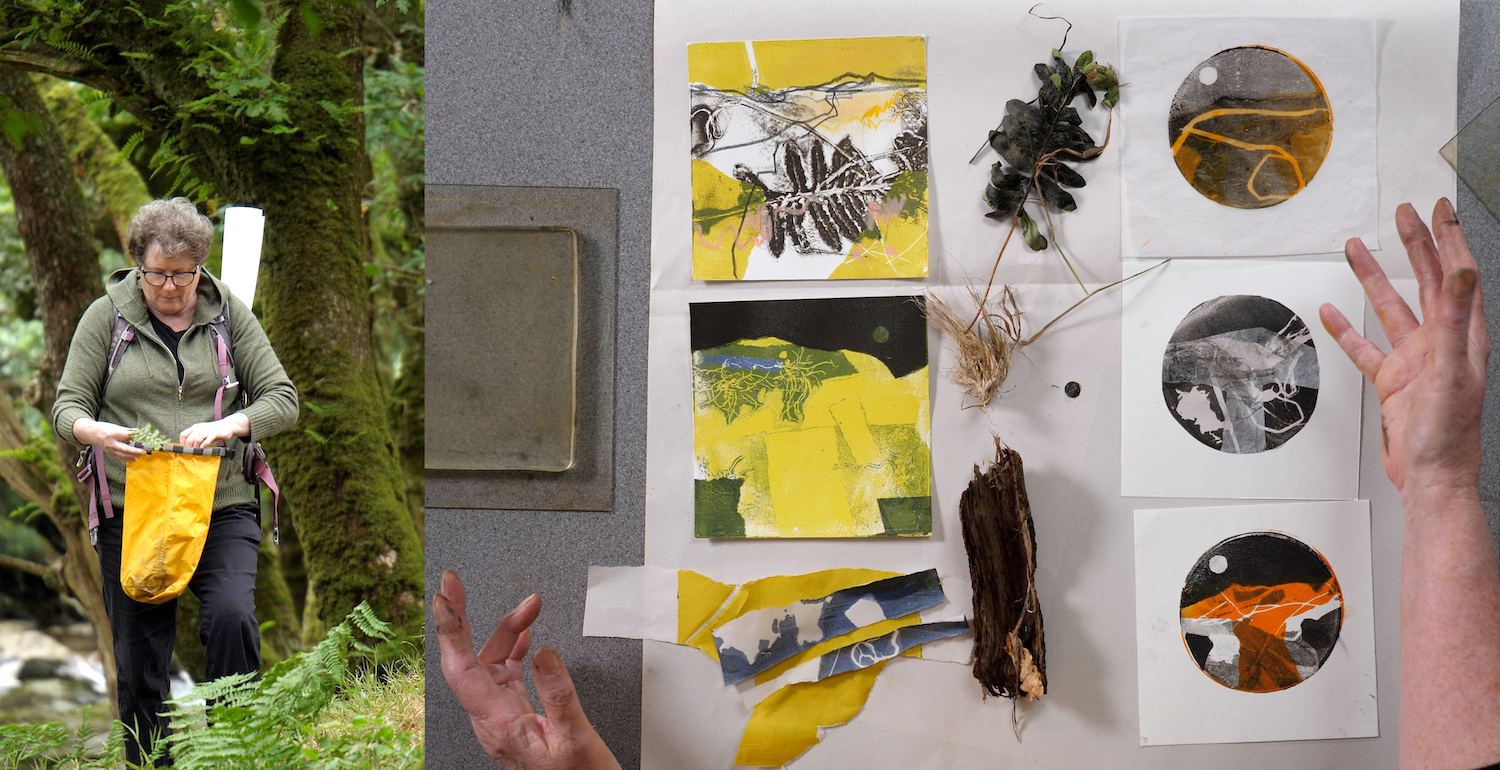
Anita Reynolds collecting material (left) and Gelli plate printing (right).
“When I am visiting and researching a location I take time to look more closely at the minutiae of the landscape rather than only focussing on the broader, larger view. I visit locations at different times of the year and in different weather conditions. These intimate studies of a place help me to gain a deeper understanding of the landscape, it encourages me to slow down and learn more about the geology, flora and history of my chosen location.
I take a sketchbook for noting down colours that I see when out and about. I find that recording the colours using words is often more useful: “the fern was a zesty yellow green with rusty red tips on the fronds”. I also take a small bag for collecting any materials I find on the ground, a camera and a pair of binoculars for any animal sightings."
.jpg)
Gelli plate print and micro photograph by Anita Reynolds.
"I use the macro setting on my camera to take close up landscape shots and store them according to the place and season, I also print them out to refer to in the studio. These minute details of the landscape are one of the ways I create colour palettes for my paintings and monotype prints. I use the foraged materials to create collage papers and monoprints that are incorporated into my mixed media works. To make these I use lightweight papers, a Gelli plate, acrylics and printing inks.”
Anita's Tips
- Note the colours you see when walking, record the location and date and any words and memories of the day.
- Use these colour studies to create your larger landscape artworks.
- As well as looking at colour you can also look for repeating patterns, textures and forms that can be used to find an abstracted approach to representing the landscape.
- Collect dead materials from the landscape such as plant forms, sticks, feathers and leaves. These can be used to make drawings and to use as home made tools or to print from.
- To create collage papers use papers that are lightweight such as tracing paper, tissue or Japanese papers.
Year-Long Online Landscape Course
The year-long online course has contributions from 16 respected landscape painters, each sharing filmed demonstrations. The artists have devised over 80 exercises for participants to complete alongside studio visits, professional development, and interviews. The pre-recorded course is delivered online over six sessions, directed and hosted by Anita Reynolds. The course is designed to be experienced from the comfort of your own studio/home, and with 18 months of access, you can really make the most of the wealth of information, exercises and tips from all of these respected landscape artists
Uniquely, the course also includes over 40 looped films of the locations these artists often visit for participants to paint from; of the coastline and moorland around Cornwall and Devon. There’s amazing drone footage, guidance, and countless tips on how to energise and improve your landscape painting practice.
View the Year-Long Online Landscape Course here.